A balanced comparison for conveyor engineers and specifiers
Lorbrand Engineering10 October 202612 min read
Introduction
Steel and composite idler rollers are both in wide use on bulk-materials conveyors, and each has a well-defined set of conditions in which it is the better choice. This article compares the two technologies across the properties that determine roller performance in service: mass and handling, wear and belt protection, corrosion, rigidity, dimensional stability, belt tracking, noise, heat dissipation, fire and impact behaviour, environmental impact and cost of ownership. It is written for conveyor engineers and specifiers, and draws on Lorbrand's four decades of designing and manufacturing steel rollers and over a decade of composite rollers.
Both technologies have genuine strengths and genuine limitations. The most effective installations deploy each type where its characteristics match the operating conditions of the position it occupies.
The evolution of composite roller technology
Steel rollers have been the backbone of conveyor systems since the earliest belt conveyors, and the technology is mature, well-understood, and standardised. Composite rollers, by contrast, have evolved significantly since their introduction in the 1980s. The earliest designs were hybrid constructions, plain HDPE tubes pressed over thin-walled steel pipes, which offered corrosion resistance but were limited by the poor mechanical properties of unreinforced HDPE.
The introduction of glass-fibre reinforced HDPE (GF-HDPE) tubes eliminated the inner steel tube, creating true all-polymer shells. However, early formulations still lacked the bending stiffness needed for heavy-duty applications. Current-generation GF-HDPE tubes, developed by specialist polymer manufacturers, offer mechanical properties and abrasion resistance that make them suitable for demanding mining applications. Specialised formulations providing flame retardancy and anti-static properties are available, though specifiers should be aware that these additives can reduce wear resistance and mechanical strength compared to standard GF-HDPE.
Weight, safety, and handling
Composite advantage
20–60%
lighter than an equivalent steel roller
A composite roller's mass is typically 20 to 60% less than the mass of an equivalent steel roller, depending largely on the wall thickness of the steel shell it replaces. For a CEMA D6 roller at 1200 mm face length, this translates from approximately 26 kg (steel) to 19 kg (composite). The ergonomic benefit during manual handling (installation, maintenance and replacement) is substantial. Manual handling injuries are among the most common causes of lost-time incidents in conveyor maintenance, and reducing unit weight by a fifth or more directly mitigates this risk.
The lower rotating mass also reduces start-up torque requirements and may modestly reduce steady-state energy consumption, though the latter depends on system-level factors including belt tension, material loading, and conveyor length, and should not be assumed without analysis.
Wear resistance and belt protection
Nuanced: depends on abrasive severity
Steel is the harder material and has superior abrasion resistance in absolute terms: it loses less material per unit time under abrasive contact. This is readily demonstrated: in a direct abrasion test, GF-HDPE wears down significantly faster than steel. Field experience from sites operating both roller types in aggressive abrasive conditions consistently confirms that steel rollers outperform composite on wear life in these environments.
What composite rollers do offer is a larger wear reservoir. A typical composite wall thickness of 15–20 mm compared to 4–6 mm for steel provides more material before the shell is worn through. However, the full wall thickness is not available as usable wear life. As the shell thins, its bending stiffness and load-carrying capacity diminish, and the manufacturer's design factor of safety is progressively eroded. A radial wear depth of 5 mm is commonly used as a planning threshold, though the actual allowable limit depends on the specific roller's design margin, operating load, and length. In moderate abrasive conditions, this usable wear reservoir could still result in longer service life than steel despite the higher wear rate. In aggressive abrasive environments, however, the wear rate of GF-HDPE can be so much higher than steel that steel rollers outlast composite.
The belt protection advantage remains regardless of wear rate. When a steel shell wears through, the resulting sharp edge can cause catastrophic belt damage, potentially destroying a belt worth hundreds of thousands of dollars in minutes. A worn composite shell does not develop sharp edges and is far less likely to damage the belt even when severely worn. The advantage lies in the failure mode rather than in wear resistance, and it can be worth far more than the roller's purchase price as insurance against belt damage. Separately, composite roller wear accelerates non-linearly as the diameter reduces due to differential surface speed effects, and excessive wear diminishes load-carrying capacity.
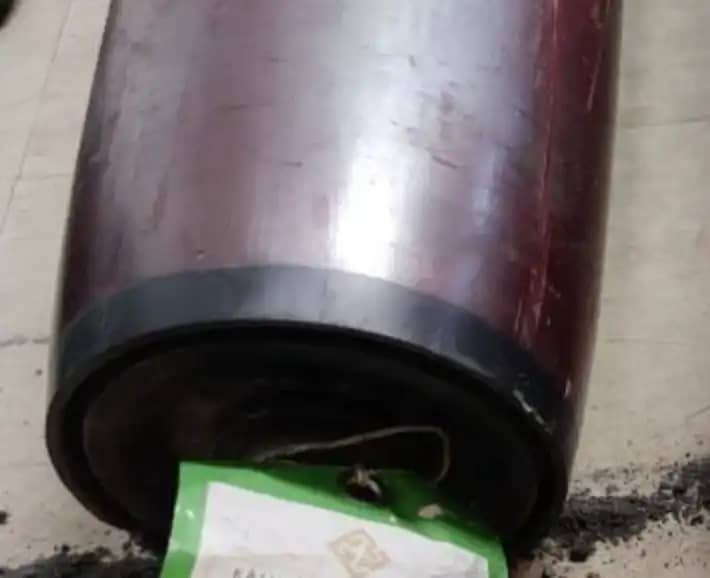
A worn composite roller
Corrosion and chemical resistance
Composite advantage
GF-HDPE is inherently immune to corrosion. In coastal installations, chemical processing plants, fertiliser handling, or acidic mine water environments, composite shells provide a decisive advantage. The shell will never rust, pit, or develop corrosion-related imbalance. Steel rollers in these environments require expensive protective coatings, galvanising, or stainless steel construction, all of which add cost and may still degrade over time.
Structural rigidity and load capacity
Steel advantage
30–70×
steel's flexural modulus (≈200 GPa) relative to GF-HDPE (3–6 GPa)
Steel's flexural modulus (approximately 200 GPa) is 30–70 times higher than GF-HDPE (3–6 GPa). While the thicker composite wall compensates substantially, it does not fully close this gap. Under heavy loads, composite shells deflect more than steel at the same outside diameter, and this deflection increases as the shell thins through wear.
For applications at the upper end of conveyor duty ratings (high belt tensions, heavy bulk densities, large idler spacing), steel remains the appropriate choice. Where composite rollers are retrofitted in place of steel, it may be necessary to specify a larger diameter to maintain acceptable deflection, which can affect clearances to belt, chute liners, and structure. Roller manufacturers should provide deflection data at both new and worn shell dimensions.
Dimensional and thermal stability
Steel advantage
Steel rollers operate in a dimensionally stable regime. Both the shaft and shell are steel, so differential thermal expansion is negligible. The bearing housing is steel (pressed or welded end disc), which does not creep, does not soften with temperature, and maintains bearing seat precision indefinitely.
Composite rollers face two distinct challenges. First, the coefficient of thermal expansion of GF-HDPE (approximately 30–80 × 10⁻⁶/°C) is significantly higher than steel (approximately 12 × 10⁻⁶/°C). Over a 1000 mm roller face, a seasonal temperature change of 30 °C creates approximately 0.4 mm of differential axial expansion between the GF-HDPE shell and the steel shaft. In rollers where the bearing housing is fixed to the shell (as in friction-welded construction), this differential can impose cyclic axial preload on the bearings, increasing raceway stress and accelerating lubricant degradation. This effect can be eliminated, but requires designs that allow an axial (sliding) movement somewhere, typically by making one shaft bearing seat a sliding fit.
Second, GF-HDPE is a viscoelastic material susceptible to creep under sustained load. In friction-welded rollers, where the bearing housing must also be GF-HDPE (the same material as the tube, required for the weld), the bearing seat can gradually enlarge over time, loosening the bearing fit. GF-PA66 (nylon) bearing housings, as used in pressed-in designs, offer substantially better creep resistance and a Vicat softening point exceeding 250 °C compared to 125–130 °C for GF-HDPE.
The TIR (Total Indicator Runout) of a composite roller, even if precisely machined at manufacture, can change over its service life due to these thermal and creep effects. Steel rollers essentially maintain their as-manufactured TIR permanently. For vibration-sensitive applications, this distinction matters.
Belt tracking and self-centring
Steel advantage
The coefficient of friction at the HDPE-on-rubber belt interface (μ ≈ 0.2–0.3) is significantly lower than steel-on-rubber (μ ≈ 0.35–0.5). This lower friction is marketed as a composite advantage (less belt cover wear, lower power consumption), but it has a significant operational consequence: reduced self-centring force. The belt's ability to correct lateral drift on a troughing idler is directly proportional to friction, and with composite rollers this restoring force is 30–40% weaker.
The practical result is that conveyors fitted with composite rollers routinely require more edge guide rollers than equivalent steel-rollered installations. Where the belt runs persistently against guide rollers, the resulting contact increases overall conveyor running resistance and causes accelerated belt edge wear, degrading the belt that the lower-friction composite roller was intended to protect. As composite rollers age and develop non-uniform wear profiles, the tracking situation progressively worsens due to wear-induced steering effects.
Noise reduction and vibration damping
Composite advantage
Composite rollers generate significantly lower operational noise than steel. GF-HDPE is a viscoelastic material that absorbs impact energy from belt splices, lump loading, and frame vibration rather than transmitting and radiating it as noise. This matters for underground mining, enclosed plants, and installations near residential areas where noise compliance is a regulatory constraint. (Underground use carries a separate fire-safety constraint; see Hot materials, fire, and impact resistance below.)
The same damping property attenuates high-frequency shock loads on the bearings, potentially extending bearing life. By contrast, steel shells transmit every impact directly to the bearing, and the cumulative effect of dynamic shock loading is a significant contributor to real-world bearing failure rates. This is one reason why composite rollers can, in certain applications, outlast steel rollers on bearing life even after removing wear and corrosion from the comparison.
However, this advantage is offset where bearing housing creep or thermal preloading degrades bearing alignment (see Dimensional and thermal stability, above). The net effect on bearing life depends on the specific roller design and operating conditions.
Heat dissipation
Steel advantage
Steel is an excellent thermal conductor. Bearing-generated heat dissipates readily through the steel end disc and shell. In composite rollers, the polymer housing acts as a thermal insulator, retaining heat around the bearing. At higher speeds or heavier loads, this can accelerate lubricant degradation. As a rough guide, bearing lubricant life halves for every 15 °C increase in operating temperature. For high-speed conveyor applications or conveyors operating in elevated ambient temperatures, this is a material consideration.
Hot materials, fire, and impact resistance
Steel advantage
Steel rollers are the clear choice for conveying hot materials: clinker, sinter, freshly blasted rock, or any material that might raise the roller surface temperature towards or beyond the Vicat softening point of GF-HDPE (125–130 °C). Steel is also more resistant to gouging by trapped metallic objects, damaged belt splice components, and sharp impact loading. While rubber-disc impact rollers (available with both steel and composite shafts) mitigate impact at loading points, steel remains more forgiving of abuse in harsh environments.
Flammability is a related and safety-critical distinction. Standard GF-HDPE is combustible: in a fire it can sustain and propagate flame and produce smoke, a serious hazard in confined underground workings. Underground applications, and underground coal in particular, therefore require fire-retardant anti-static (FRAS) grade composite rollers, and even these should be specified only after a site fire-risk assessment. As noted in the section on composite roller evolution, FRAS additives also reduce wear resistance and mechanical strength relative to standard GF-HDPE. Steel, being non-combustible, carries no such restriction and remains the default where fire risk governs.
Environmental considerations
Microplastic generation
≈10 t
GF-HDPE wear debris a 5 km overland conveyor can deposit over its operating life
Composite roller shells shed GF-HDPE microplastic particles as they wear. The quantities are not trivial. A 5 km overland conveyor can deposit approximately 10 tonnes of GF-HDPE wear debris over its operating life. This debris includes released glass fibres. Steel roller wear generates iron oxide dust, which is inert and naturally occurring. Operators in environmentally sensitive areas should factor microplastic generation into their environmental risk assessments.
Steel rollers are fully recyclable through standard scrap metal channels. GF-HDPE composite rollers cannot be placed in general plastics recycling, because the glass fibres damage processing equipment and contaminate recycled output. Dedicated collection and specialist processing are required. Lorbrand accepts returned composite rollers for processing into recycled-content products where logistics permit.
Total cost of ownership
Composite rollers generally carry a higher unit purchase price. Whether they deliver a lower total cost of ownership depends entirely on the application. A meaningful comparison must include installation labour (lower for composites), expected wear life in the specific abrasive environment, maintenance frequency and logistics, impact on belt life (composites eliminate sharp-edge belt damage), energy consumption (system-dependent), and disposal costs. Neither technology is inherently cheaper over its full lifecycle. The answer depends on the conditions.
Application guide
The following table summarises the conditions that favour each roller type:
Favours composite
Favours steel
Corrosive or chemical environments
Very high belt tensions and heavy loads
Moderate abrasion (larger wear reservoir)
Aggressive abrasion or hot materials
Manual-handling safety is a priority
Severe impact loading zones
Noise-sensitive environments
Precise belt tracking is critical
Belt protection is paramount (high belt cost)
High-speed applications (bearing heat)
Long overland conveyors (weight savings)
Environmentally sensitive areas (inert wear debris, no microplastics)
Underground is a special case. Composite rollers offer real noise and weight benefits in confined workings, but standard GF-HDPE is combustible. Underground installations must therefore use fire-retardant anti-static (FRAS) grade composite rollers, specified only after a site fire-risk assessment. Where fire risk is the overriding concern, steel remains the safer choice.
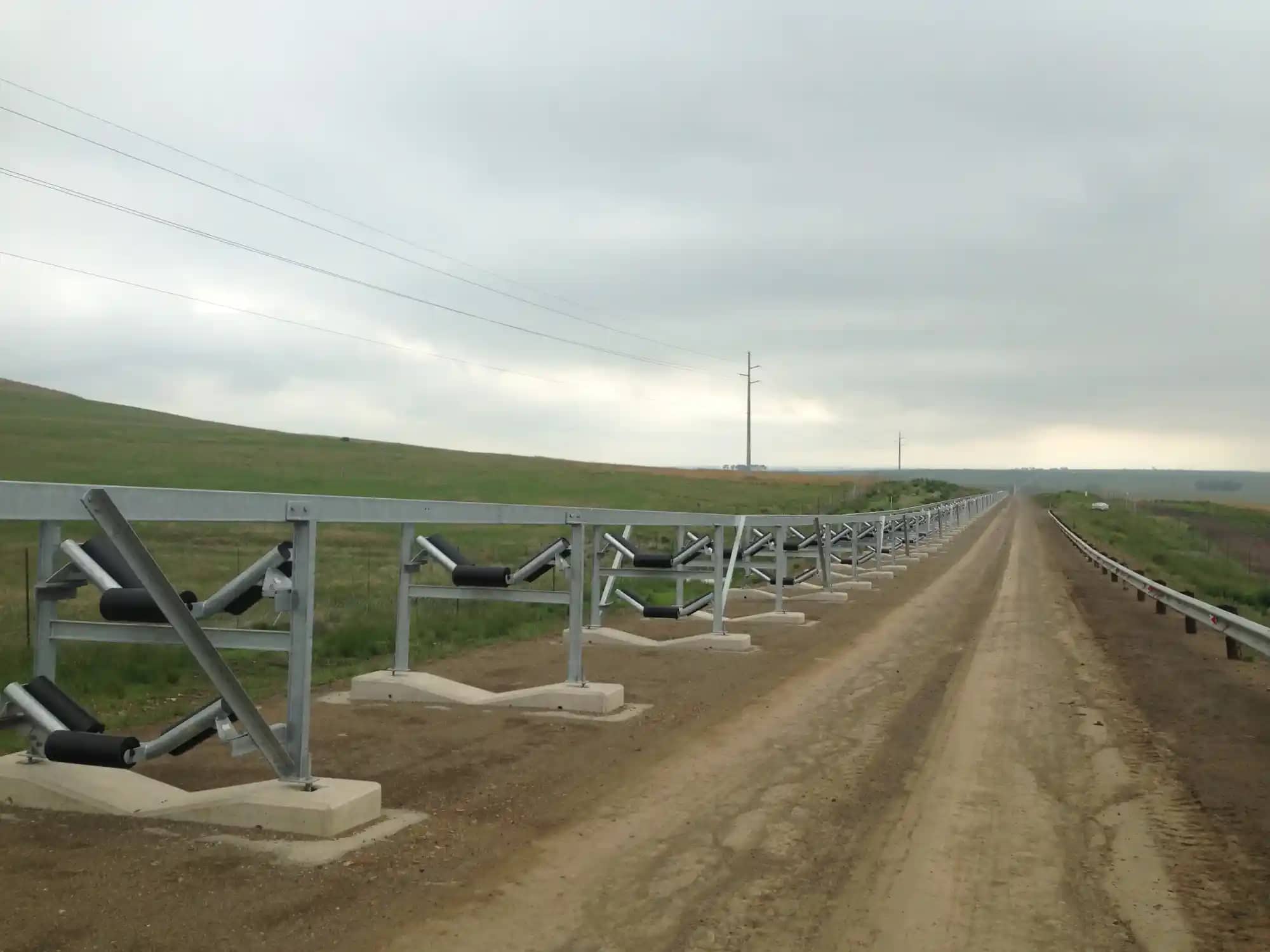
Many installations benefit from using both types: composite rollers on elevated gantries or difficult inclines and terrain where their advantages dominate, and steel at easier locations for change-out, high-temperature areas, or positions requiring precise tracking control.
Conclusion
Steel and composite conveyor rollers are complementary technologies. Each has characteristics that make it the better choice in specific conditions. Steel offers greater rigidity, dimensional stability, belt tracking, heat dissipation, and recyclability. Composite offers superior corrosion resistance, weight reduction, noise damping, and belt protection.
The engineering task is to match the roller to each application. This requires honest data from manufacturers about both the strengths and the limitations of their products, and informed judgement from engineers about which characteristics matter most for each conveyor position.
Lorbrand manufactures both steel and composite rollers because both have an essential role in modern conveyor systems. We encourage users to evaluate each application on its merits, using the considerations outlined in this article, and to contact us for application-specific guidance.
Frequently asked questions
Can composite rollers be used underground?
Only in fire-retardant anti-static (FRAS) grades, and only after a site fire-risk assessment. Standard GF-HDPE is combustible: in a fire it can sustain flame and produce smoke, a serious hazard in confined workings. Where fire risk is the overriding concern, steel rollers remain the safer choice.
How much lighter is a composite roller than a steel roller?
Typically 20 to 60% lighter, depending largely on the wall thickness of the steel shell. A CEMA D6 roller at 1200 mm face length weighs about 19 kg in composite against about 26 kg in steel, which reduces manual-handling risk during installation and change-out.
Are composite rollers cheaper over their life than steel rollers?
That depends on the application. Composite rollers usually cost more to buy. A fair comparison includes installation labour, wear life in the site's abrasive conditions, maintenance logistics, belt protection from sharp worn shells, energy use and disposal. Neither type is inherently cheaper over its full life.
Which roller type suits hot materials?
Steel. Clinker, sinter, freshly blasted rock or any material that can heat the roller surface towards the 125–130 °C Vicat softening point of GF-HDPE calls for steel rollers, which also resist gouging by trapped metal and sharp impact better.